Curaçao Hato Caves: Is It Worth It?
Everything you need to know about visiting the Hato Caves in Curaçao: tickets, tour times, what to expect inside, accessibility, and a straight answer on whether it is worth the trip.
200,000 Years of History Beneath Your Feet
The Hato Caves ("Grotten van Hato" on local signs) are limestone chambers under the plateau next to the airport, formed when this part of Curaçao was still seabed. The rock is fossilized coral reef; a few hundred thousand years of rainwater dissolved it into the stalactites, columns, and chambers you walk through today.
The question everyone asks is whether they deserve an hour of a short vacation. Usually yes, at the right moment. Here is what you will see, what it costs, and when to skip it.
What to Expect Inside the Caves
Recalibrate if you have toured Carlsbad or Waitomo: Hato is modest. Medium-sized chambers connected by concrete walkways, covered in about 45 minutes. What it lacks in scale it makes up in density: formations, fossils, bats, and petroglyphs packed into one short loop.
Formations
Stalactites hang in tight clusters, some thin enough to pass light. Stalagmites rise to meet them, and in several spots the two have fused into full floor-to-ceiling columns. The one nicknamed "The Madonna" (it reads as a robed figure) is the caves' unofficial icon. Flowstone spills over the ledges in ochre, rust, and cream, tinted by the iron and calcium in the water.
The distinctive part is the rock itself. Because the limestone is old reef, coral is embedded in the walls: brain-coral patterns, branch impressions, shell fossils. You are looking at a reef that grew 200,000 to 300,000 years ago, now ten meters above sea level.
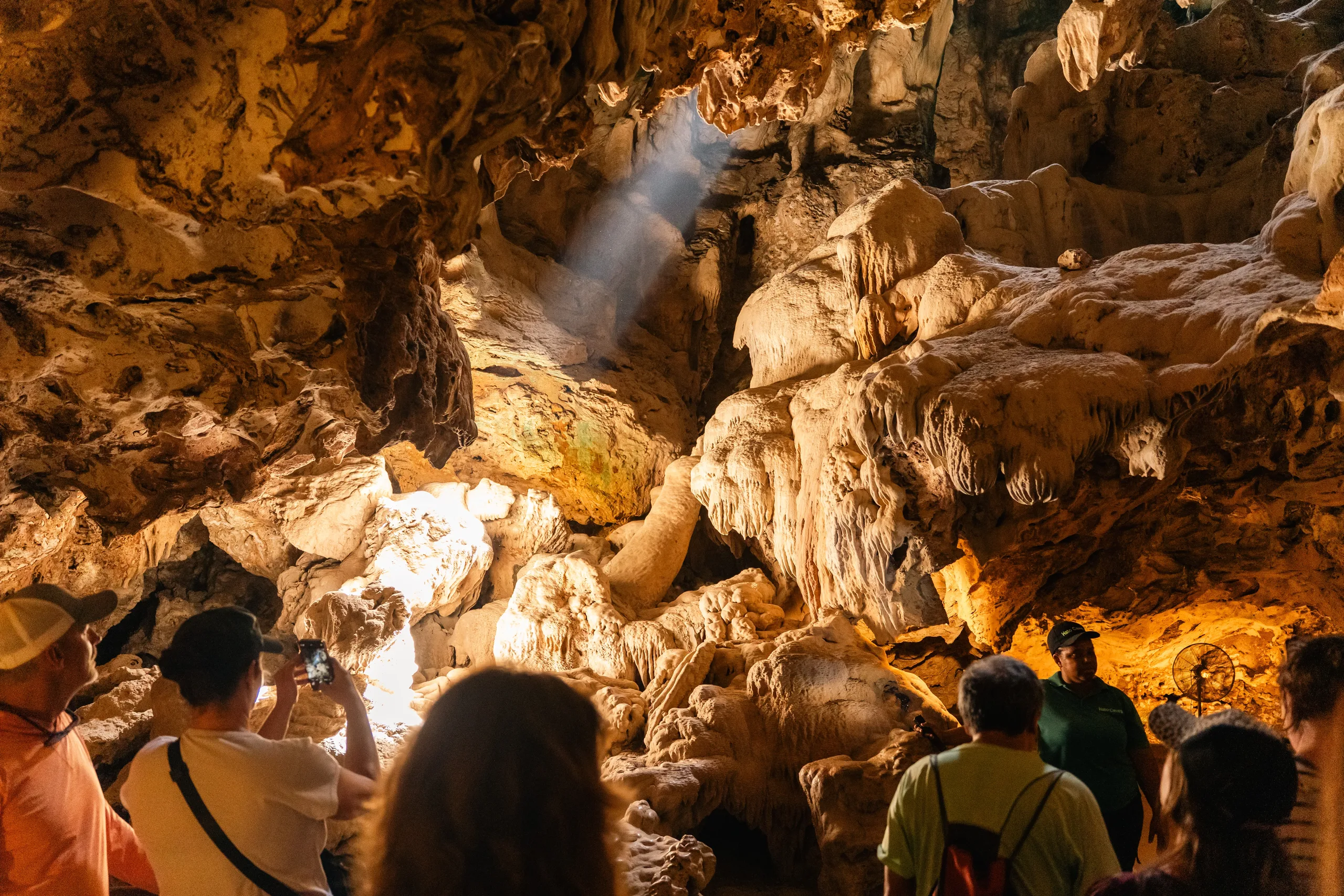
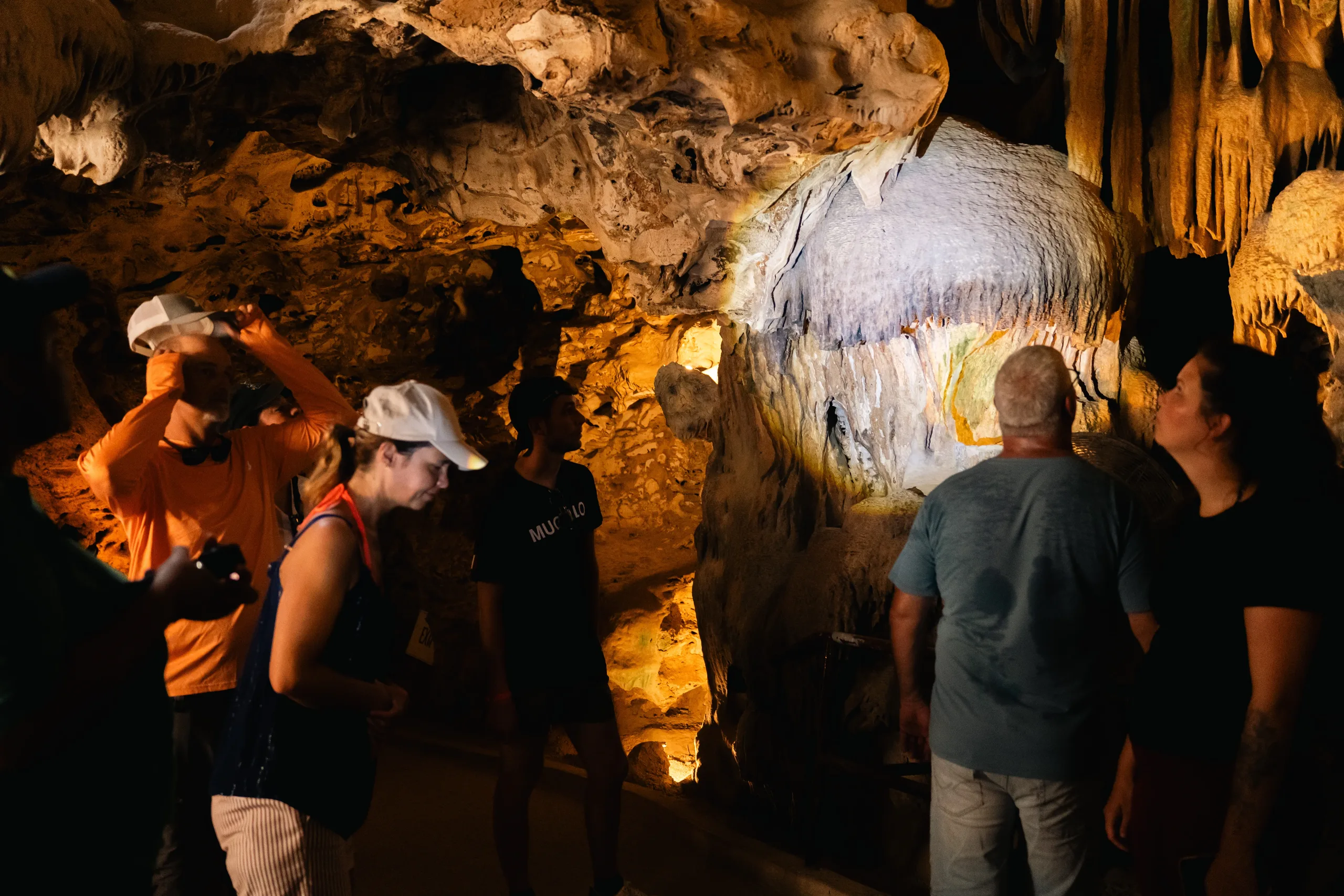
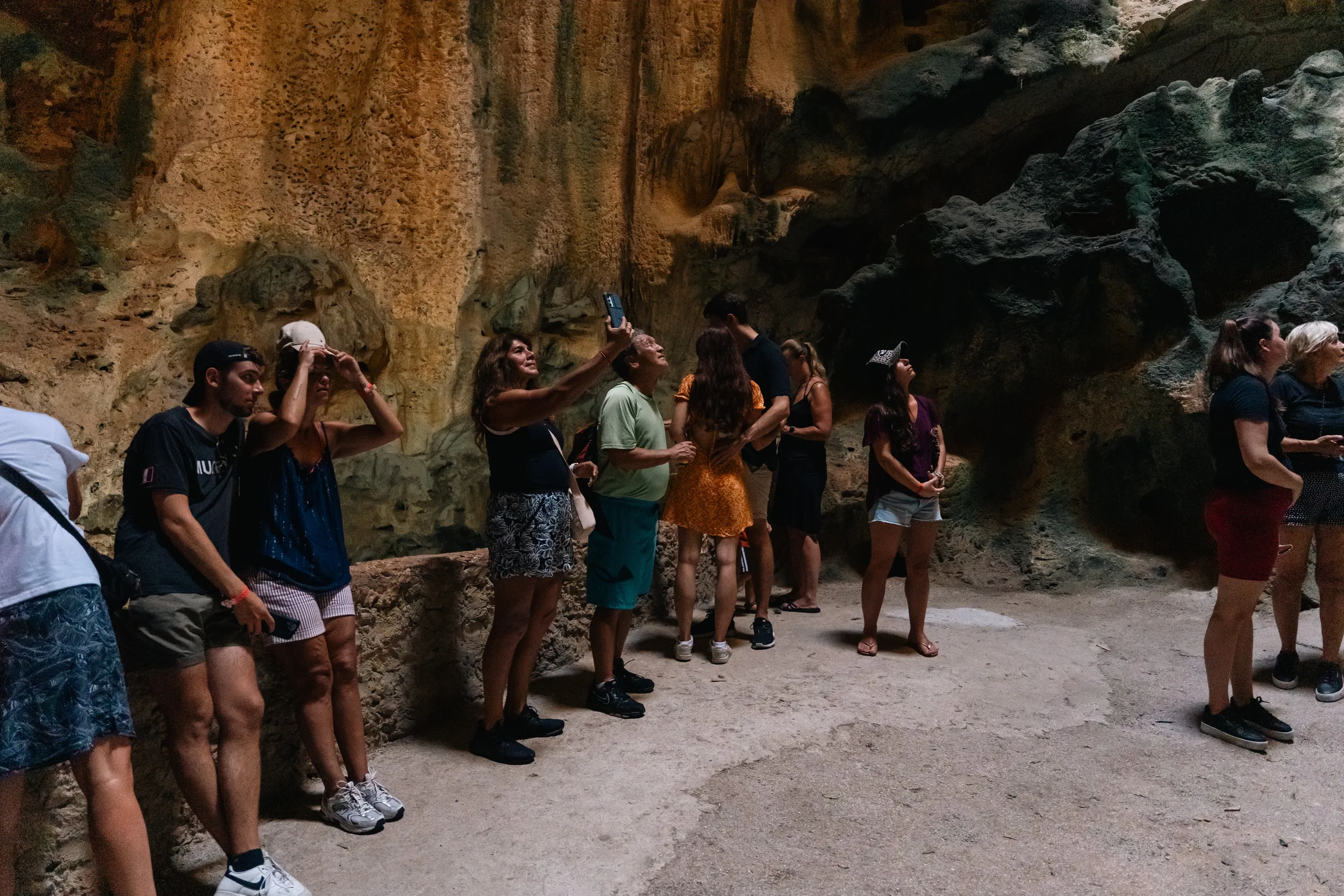
Cave Pools and Water Features
Several chambers hold shallow rainwater pools, still enough to mirror the ceiling: the guides use them for a reflection effect partway through the tour. They are roped off, so no swimming. In the rainy season (October through January) the stalactites drip actively, which is the whole cave-building process happening in front of you, one drop at a time.
Bat Colonies
The caves roost colonies of long-nosed fruit bats (Leptonycteris curasoae), found only on Curaçao, Bonaire, and parts of Venezuela. They hang in clusters in the darker recesses and the guide will point them out. They stay put: the walkways are routed to give them space, and nothing swoops at you.
Arawak Petroglyphs
Near the entrance, faded drawings left by the Arawak (the island's indigenous people) are still visible, an estimated 1,500 years old. Simple figures and symbols whose meanings archaeologists still argue about, and easy to walk past if the guide does not stop you. Almost nothing of the Arawak presence survives anywhere else on Curaçao (no standing structures, few dedicated exhibits), which is why these faint markings deserve a long look.
The Garden
A small garden of cacti and aloe sits at the entrance among exposed limestone. Guides use it to explain how the island rose from the sea floor, and why Curaçao looks nothing like its volcanic neighbors.
Tour Details
Guided tours only: you cannot explore on your own. Departures run roughly hourly, first around 9:00 AM, last at 3:30 or 4:00 PM; the schedule shifts a little by season, so check before you drive out. Tours take 45 minutes to an hour in groups of about 15-25. English and Dutch are standard; Spanish and Papiamentu on request. We have stood through enough of these tours to tell you the guide matters: some are very good, some recite.
The pace is easy: concrete paths, handrails, stops at points of interest. No crawling, no ropes, no helmets. A walking tour, not a caving expedition.
Tickets and Pricing
| Category | Price (approximate) |
|---|---|
| Adults (12+) | $10 (NAf 18) |
| Children (4–11) | $8 (NAf 14) |
| Children under 4 | Free |
Tickets are sold at the entrance. No advance booking for individuals. Cash (dollars or guilders) and major cards both work; groups of 10+ can arrange a small discount by contacting the caves directly. Most structured activities on the island run $40-100+ per person, so $10 for a guided hour is about as cheap as Curaçao gets.
Getting There
The caves sit on F.D. Rooseveltweg on the north side of the island, about 2 kilometers from Hato International Airport. From Willemstad the drive takes 15-20 minutes; from Jan Thiel or Mambo Beach, 20-25. The entrance is signed from the main road, with a free lot for 30-40 cars that only fills on heavy cruise days.
By rental car: Easiest. Point Google Maps at "Hato Caves" and go. The roads are straightforward.
By taxi: $15-25 one way from Willemstad. Negotiate a round trip up front or arrange the pickup. Taxis do not cruise this area, and you cannot flag one down when you are done.
By public bus: Konvoi routes pass on Rooseveltweg, but the stop is a 10-15 minute walk from the entrance and frequency is unreliable. For the patient only.
From the airport: A 5-10 minute taxi. On a long layover this is a decent plan: the caves are naturally cool, you will not get sweaty, and you are back at the terminal within two hours.
Accessibility Notes
Concrete pathways throughout, handrails in most sections, and roughly 50-70 steps in total, up and down. The stairs get slippery in the rainy season.
Wheelchairs: No. The stairs and narrow points make the route impossible for anyone who cannot manage steps.
Limited mobility: Doable if you can take stairs slowly with support. Tell the guide at the start and they will adjust the pace.
Children: Fine from about age 5: the bats are usually the hit. The main job is keeping small hands off the formations (skin oils damage them). Under-3s tend to get fussy in the dark.
Temperature: A steady 22-24°C (72-75°F) inside against 30-35°C outside, and the change hits the moment you enter. Coming off a hot beach, it is the best air-conditioning on the island. Visitors who run cold may find it slightly chilly after 30 minutes, but a layer is rarely needed.
Claustrophobia: Ceilings run about 3 to 15 meters and there are no tight squeezes. If you can walk an office corridor, you can walk this. But it is underground, dim, and one-way: once the tour starts, there is no turning back to the entrance. Decide before you buy the ticket.
What Makes Hato Caves Special
Not scale: Hato is not competing with Mammoth Cave or Postojna. What it has is specificity. In most caves the rock is just rock; here the walls are visibly old reef, and you can trace the coral with your eyes. The petroglyphs are one of the few in-situ Arawak traces left on the island. The bats are an endemic species you will not easily see anywhere else. And the guides tie it together well enough that you leave understanding how the island itself was made.
Pros and Cons
| Pros | Cons |
|---|---|
| Affordable ($10 per adult) | Small compared to major cave systems |
| Cool interior, a real break from midday heat | Not wheelchair accessible |
| Fossilized coral walls you can read like a reef | Tour quality varies by guide |
| Arawak petroglyphs add historical depth | Petroglyphs are faded and easy to miss |
| Endemic bat species in its natural roost | Can feel rushed with large groups |
| Five minutes from the airport | Not worth a long detour on its own |
| Best rainy-day option on the island | Low light limits photography |
Is It Worth It?
Go if: it rains. Curaçao has almost no indoor attractions, and this is the best of them. Also go if you care about geology or indigenous Caribbean history, if you have kids aged 5-14 who need a beach break, or if you are killing time near the airport.
Fit it in if: you have five or more days and want variety. Door to door it costs about an hour and $10 a head; pair it with a nearby stop (below) and you have a solid half day.
Skip if: you have 2-3 days total. Spend them on the beaches, on Punda and Otrobanda, and on the turtles at Playa Grandi instead. Same if you are a caver who has done the big systems. Hato will feel small, because it is.
Combine With: Nearby Attractions
The caves sit in the north-central part of the island, which makes them a natural first stop on a non-beach day:
Shete Boka National Park (30 minutes west)
Shete Boka ("Seven Mouths") is a raw stretch of north coast where Atlantic swells slam into rock inlets. At Boka Tabla you stand inside a half-collapsed cave and watch the ocean surge in through the opening; walking trails along the coast link several more bokas. About $6 per person, allow 1-1.5 hours. Caves plus Shete Boka is the island's best geology double bill: 3-4 hours including driving, with lunch at Jaanchi's in Westpunt (the famous iguana soup is optional) or Landhuis Daniel in Barber.
Christoffel National Park (40 minutes west)
The island's biggest park, around its highest point (Mount Christoffel, 372 meters). The summit hike takes 1.5-2.5 hours round trip; the park opens at 6:00 AM and stops admitting hikers at 10:00 AM so nobody climbs in peak heat. There are shorter trails, a driving route, and resident Curaçao white-tailed deer. About $12 per person. For a full nature day: hike at dawn, swim at Grote Knip or Playa Kalki, then the caves in early afternoon when the 22°C interior is at its most persuasive. Details in our Christoffel Park guide.
Curaçao Ostrich Farm (10 minutes)
On the same stretch of Rooseveltweg. Guided safari-truck tours where you see and feed the birds, about $17 per adult. Touristy, yes, but kids rate it, and with the caves it fills a family half-day.
Willemstad (15 minutes)
Close enough to spend the rest of the day in town: the Queen Emma pontoon bridge, Punda's Handelskade waterfront, local food at the Marshe Bieu, and the Kura Hulanda Museum's sobering exhibition on the Atlantic slave trade. Our Willemstad walking guide maps the route.
So is it worth a stop?
Yes, as long as you slot it right. At $10 and under an hour, the fossilized reef walls, the Arawak drawings, and the endemic bats are fair value, and no beach on the island offers any of them. Do not build a day around the caves. Attach them to a rainy morning, an airport window, or a west-end loop, and you will walk out glad you went.
Frequently asked questions
- Is Hato Caves worth visiting?
- Yes, if you slot it right. The caves are modest by world standards but dense with formations, fossils, bats, and Arawak petroglyphs, and the guided walk takes about 45 minutes. Pair it with a nearby stop rather than building a whole day around it, and skip it only if you have toured major cave systems and expect that scale.
- How much does Hato Caves cost?
- Entry is about $10 (NAf 18) for adults and $8 (NAf 14) for children, which includes the guided tour. Most structured activities on the island run $40 or more per person, so a guided hour underground is one of the cheapest tickets on Curaçao. Check current prices before you go.
- How long does a Hato Caves visit take?
- The guided walk through the chambers takes about 45 minutes, and the small garden area at the entrance adds a little more. Plan on roughly an hour on site, which is why the caves pair well with nearby stops instead of filling a day.
- What do you see inside the Hato Caves?
- Stalactites and stalagmites fused into full columns, flowstone tinted ochre and rust, still cave pools, a resident colony of long-nosed fruit bats, and 1,500-year-old Arawak petroglyphs near the entrance. The limestone is fossilized coral reef, so coral and shell fossils show in the walls throughout.
- Can you visit Hato Caves without a rental car?
- Yes. The caves sit next to the airport, a taxi from Willemstad runs about $15 to 25 one way, and our half-day tour includes the caves with transport and timing handled. Agree on a round-trip taxi price up front if you go that route.